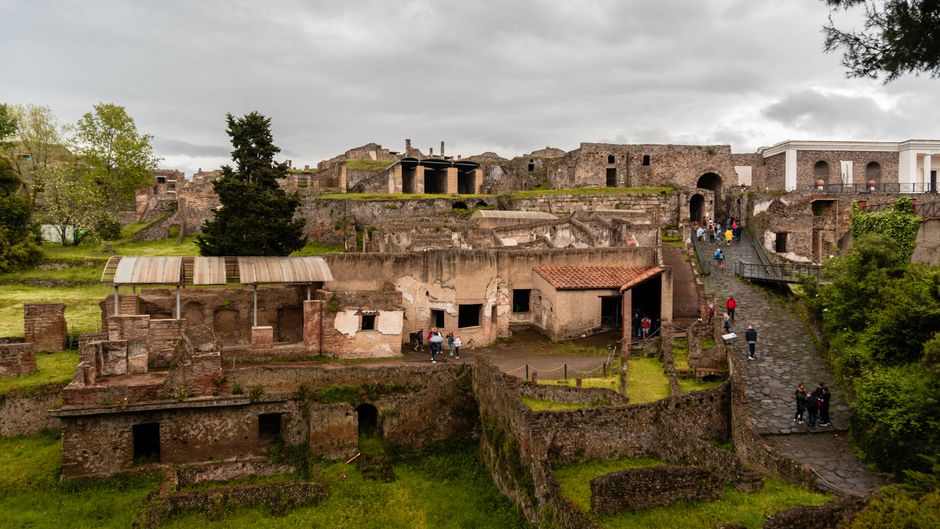
The Walls Are Finally Talking
Deep inside the ruins of Pompeii, along a narrow corridor that once connected two grand Roman theatres, there are hundreds of messages scratched into the plaster. Love notes. Insults. Shopping lists. Political endorsements. The mundane and the profound, layered on top of each other across centuries of daily life, all of it frozen the moment Mount Vesuvius erupted in 79 AD.
For nearly two millennia, many of those inscriptions sat hidden in plain sight, too faded or too faint for the naked eye. Now, an international research team is using modern imaging technology to bring them back to life, and the results are offering an extraordinary window into the world of ancient Rome.
What the Technology Is Revealing
The team is applying techniques that go beyond conventional photography, using methods like multispectral imaging and 3D surface mapping to detect subtle variations in the plaster that the human eye simply can't process. What emerges are inscriptions that had essentially become invisible over time, now suddenly legible again.
The corridor in question wasn't a glamorous public space. It was a utilitarian passage, the kind of place where workers, theatre-goers, and vendors would linger. That's exactly what makes it so valuable to historians. Official Roman inscriptions were formal and curated. Graffiti was raw and real.
Researchers have already uncovered references to gladiators, comments on local politics, and the kinds of casual personal messages that wouldn't look out of place on a modern message board. The sheer volume of writing suggests this corridor was a hub of social activity.
Why This Matters Beyond the Ruins
Pompeii has long been one of the world's most studied archaeological sites, but the pace of discovery has accelerated dramatically in recent years thanks to technology. Projects like this one are part of a broader wave of digital archaeology, where remote sensing, AI-assisted text recognition, and high-resolution scanning are transforming what researchers can learn from ancient sites without disturbing so much as a pebble.
For historians and classicists, this kind of discovery is invaluable. Written records from ordinary Romans, not emperors or senators, but merchants, freedmen, theatre fans, are rare. Every new inscription adds texture to our understanding of what daily life actually felt like in the ancient world.
Pompeii's Ongoing Revelations
In the last decade alone, Pompeii has yielded remarkable finds: intact ceremonial chariots, a fast-food shop with vivid painted menus still on the walls, the preserved remains of a man who appears to have been fleeing the eruption when he was struck by a falling block. The site continues to surprise even the most seasoned archaeologists.
The graffiti project is ongoing, and researchers expect to catalogue hundreds more inscriptions as the imaging work continues. Each one is another data point: another small human voice echoing forward across two thousand years.
As CBC reports, this is ancient history at its most immediate: not kings and battles, but people just living their lives, scrawling on walls, not knowing anyone would ever read what they left behind.
Source: CBC Top Stories, original article

