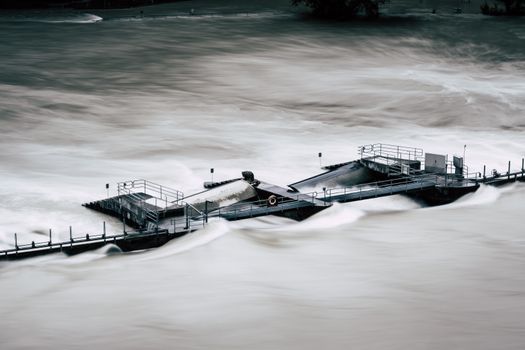
Ottawa sits at the confluence of the Ottawa, Rideau, and Gatineau rivers, and residents of riverside communities like Constance Bay, Cumberland, and Britannia know all too well the anxiety that accompanies spring melt and heavy rain events. So Google's announcement this week of a new AI system that can mine historical news archives to dramatically improve flash flood prediction is attracting significant attention from local researchers and emergency management professionals.
The system, developed by Google Research in collaboration with flood scientists, works by training machine learning models on thousands of historical news reports about past flooding events. By identifying patterns in the language used to describe the conditions that preceded floods, storm intensity, ground saturation levels, seasonal timing, upstream precipitation, the AI can build predictive models that substantially outperform traditional hydrological approaches based on physical measurements alone.
Why This Matters for Ottawa
Ottawa and the broader Ottawa Valley have been dealing with increasingly severe and unpredictable flooding in recent years. The spring floods of 2017 and 2019 caused hundreds of millions of dollars in damage across Quebec and Ontario, displacing thousands of residents and overwhelming both municipal and provincial emergency response systems. Climate change is making such events more frequent, as warmer winters produce faster, more intense spring melts and the storm systems that move through the Ottawa Valley are delivering heavier precipitation events.
The Ottawa Valley Disaster Relief Committee and the City of Ottawa's emergency preparedness division both maintain flood prediction and early warning systems, but these rely primarily on river gauge readings and weather service forecast data. A system that can integrate text-based historical knowledge, including the informal, on-the-ground detail captured in local news reporting, could provide meaningful additional lead time for flood warnings.
AI Meets Local Journalism
There is also something poetically fitting about the approach for a city that is home to numerous federal research institutions, including the National Research Council and Environment and Climate Change Canada, both of which have significant climate and hydrological modelling programs. The idea that digitized archives of local and regional news reporting could become a training resource for flood AI is an unexpected validation of the kind of granular, place-based journalism that community news organizations produce.
Google says the system has shown particular promise in regions where historical flood data is sparse or poorly digitized, making news archives an invaluable secondary data source. For the Ottawa Valley, where newspapers like the Ottawa Citizen have been reporting on river flooding since the 1800s, there is a remarkably rich historical record available.
Next Steps
Google has not yet announced deployment timelines for the flood prediction system, but the company indicated it is working with emergency management agencies in multiple countries to pilot the technology. Canadian emergency management officials at Public Safety Canada will be watching developments closely, given Ottawa's particular vulnerability and the country's broader flood risk exposure.
Source: TechCrunch