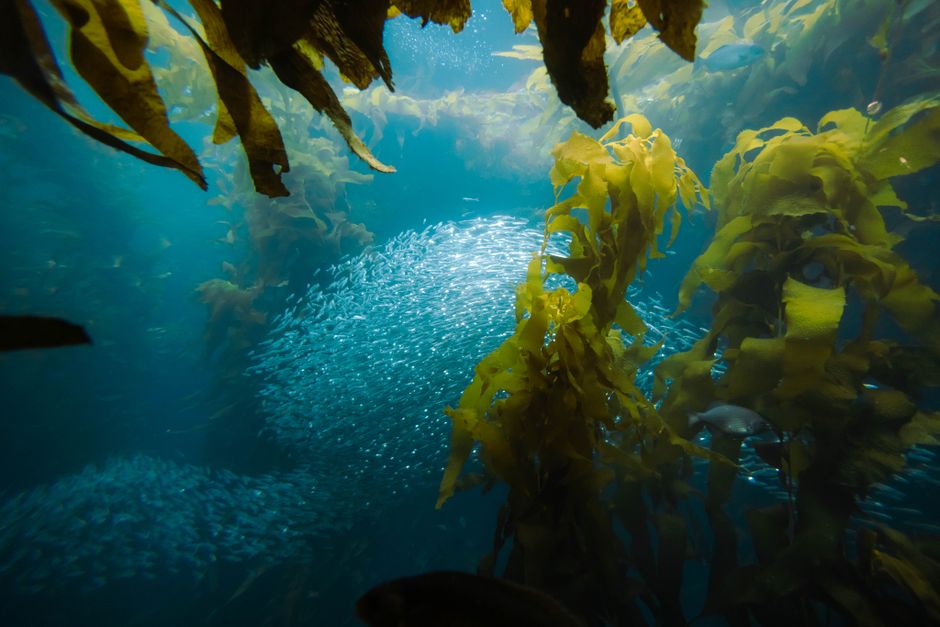
A new study out of British Columbia is rewriting what scientists thought they knew about Canada's Pacific coastline. Researchers at the University of Victoria have found that a stretch of the Georgia Strait near Comox and Denman Island was once blanketed in bull kelp forest, about 5.5 million square metres of it, roughly ten times the amount long assumed to be the natural baseline.
A much greener past
Bull kelp is one of the most recognizable plants in coastal B.C. waters: long, ropy stalks topped with a gas-filled bulb that floats at the surface, forming dense canopies that sway with the tide. These forests are the rainforests of the sea. They shelter fish, feed urchins and otters, buffer shorelines from storms, and lock away carbon.
The UVic findings suggest the northern Salish Sea was far richer in this habitat than today's maps imply. If 5.5 million square metres once thrived near Comox and Denman Island, then the modern, sparser kelp beds aren't a stable natural state. They're the remnant of a much larger system that has quietly shrunk over time.
Why the baseline matters
The number researchers choose as a starting point shapes every decision that follows. If conservationists assume today's reduced kelp coverage is normal, they may set their sights too low. But if the true historical baseline is ten times larger, it reframes the loss as far more severe, and sets a more ambitious target for what restoration could actually achieve.
This is a well-known trap in ecology called 'shifting baseline syndrome,' where each generation accepts a slightly more degraded environment as the norm because they never saw what came before. Studies like this one help reset the reference point using historical and physical evidence rather than living memory.
Kelp under pressure
Kelp forests along the Pacific coast have struggled in recent years. Marine heat waves, warming ocean temperatures, and booming populations of sea urchins, which mow down kelp when their natural predators decline, have all taken a toll. In some regions, lush canopies have collapsed into bare 'urchin barrens' in just a few seasons.
Understanding how much kelp the Salish Sea can support gives scientists and coastal communities a clearer goal. Restoration projects, from urchin removal to replanting efforts, become easier to justify when the potential payoff is measured against a fuller picture of the past.
A national story
Though the research is rooted in B.C. waters, the implications stretch across Canada. Healthy kelp forests pull carbon dioxide from the atmosphere, support commercial and Indigenous fisheries, and protect shorelines that an increasing number of Canadians call home. As the country looks for nature-based ways to fight climate change and shore up biodiversity, the seafloor off Vancouver Island is a reminder that some of our most powerful ecosystems are hidden just below the surface, and that they were once much, much bigger.
Source: CBC News British Columbia

